Showing posts with label ORF. Show all posts

April 12, 2021

Exploring India’s Economic Diplomacy with the US


The following originally appeared in Malancha Chakrabarty and Navdeep Suri (eds.), A 2030 Vision for India’s Economic Diplomacy, GP-ORF Series, Global Policy & Observer Research Foundation, 2021. The article was reprinted in The Print on April 27, 2021.


The US is India’s most important economic partner today. In 2019-2020, it was India’s single largest trade partner, accounting for almost US$89 billion (11 percent of India’s total) in two-way goods trade (1). It is the fifth-largest source of incoming foreign direct investment (FDI) (2). However, these figures arguably understate the importance of the economic partnership. Services trade is a major component of bilateral commerce, accounting for over one-third of total trade (37 percent). Over 2,000 US companies currently have a presence in India, some—including such major corporations as GE, Cisco, Microsoft, and Amazon— being significant employers. In 2018-2019, over 200,000 Indian students studied in the US, a number that has reduced somewhat due to the COVID-19 pandemic. India provides a massive user base for US technology companies; it is already home to the largest number of Facebook users and other technology giants—many prevented from entering China’s market—see immense potential in India. About one in seven Silicon Valley startups were founded by Indians, with the impact of Indian-born entrepreneurs in the US felt equally in areas such as the biological sciences (3). While India’s other economic relationships—with Europe, China, Japan, Southeast Asia, and the Gulf—are also intensifying, the US for now holds particular importance for India’s economic diplomacy. 

But there are also areas where the US and India do not hold much value for each other—yet. Both are consumer-driven economies and net importers (they rank first and third, respectively, in terms of current account deficits). Regardless of the political party in power in both countries, ensuring employment for the middle class will be essential, making it difficult to offer concessions on trade or manufacturing. Barring select sectors, neither is a major exporting powerhouse of manufactured goods, along the lines of China, Germany, Japan or South Korea. In the US’s case, this is a consequence of its economic trajectory; in India’s case as a developing economy, it is often a product of insufficient competitiveness. Infrastructure is also not always a strong suit for the two countries, nor is government-backed institutional investment. At the same time, some areas that were previously underdeveloped have come online in recent years, such as energy and defence, two significant areas of trade and commercial cooperation that have emerged only relatively recently. 

India’s economic engagement with the US over the next decade can be assessed along five dimensions—trade, migration, capital flows, technology, and standards and regulations. Trade is likely to remain a fraught subject but will depend in large part on the evolution of US manufacturing, India’s industrial development and the resolution of trade frictions. Migration will see bumps along the road but could quite conceivably result in a tightening of relations. Capital flows will depend in large part on the success of India’s post-COVID-19 economic recovery. Technology offers perhaps the greatest potential for accelerated economic links between the two countries, with wide-ranging effects on security, communications and the environment. Finally, standards and regulations may offer one of the more significant areas of India-US engagement, with global implications. As two large democratic economies, India and the US will have the potential (along with Europe and Japan) to shape global standards on sustainable development, international lending, telecommunications and banking systems, among a host of other areas. For India’s economic diplomacy over the next decade, these areas will be worth greater emphasis. India’s development will require sourcing critical goods, investment and technologies; ensuring market access; absorbing best practices and knowledge; and leveraging international agreements for domestic competitiveness. 

Trade: Frictions Amid Flattening 

Trade in goods is likely to remain a contested area, not just between India and the US, but globally. After the end of the Cold War, the world witnessed an enormous growth of cross-border trade, rising from 39 percent of global GDP to 61 percent in 2008. But following the global financial crisis, trade has plateaued, falling to 59 percent of global GDP by 2018. With the proverbial pie no longer growing, trade is increasingly viewed in zero sum terms. This also applies, if to a lesser degree, to services trade, as governments continue to prioritise employment growth in critical value-add sectors. 

Trade is also extraordinarily politicised, for two reasons. One is sector-specific sensitivities. In both India and the US, narrow politically-mobilised constituencies can exert considerable influence over broader trade negotiations—including multilateral negotiations as at the World Trade Organization—if they fear becoming disadvantaged. For example, in recent years, American medical device, pharmaceutical and dairy industries have lobbied the US government to take action against India for protecting its markets. Similarly, the retail and agricultural sectors in India have been resistant to trade liberalisation. 

While sector-specific disputes have long been a feature of trade relations, an additional factor—especially after 2008—has been concern over employment. In both the US and India, overall growth figures since the turn of the millennium have been encouraging (in fact, the US and India are the second and third largest contributors to global growth in that period). However, median incomes in the US have not grown significantly, while employment growth has not matched the demographic potential in India. Ensuring jobs has become a concern for the leaderships of both countries amid fears of jobless and uneven growth, no matter the political party in power. Making concessions on merchandise trade has consequently become more difficult. 

Nonetheless, there have been opportunities for growth in bilateral relations. Prior to the COVID-19 pandemic, bilateral trade in goods and services had climbed from US$60 billion in 2009 to US$146 billion in 2019 (4). Indian purchases of energy (including liquefied natural gas), defence and commercial aviation had contributed further to US exports and narrowed the US deficit with India, which had been a point of focus for former US President Donald Trump. In a post-pandemic world, goods trade and supply chains will also be more closely associated with national security concerns and political trust. These factors do present some opportunities to bolster trade, including in key areas such as healthcare. Efforts at rerouting supply chains to ensure resilience offer additional opportunities. These may, in time, translate into select trade groupings and arrangements, even if recent efforts at multilateral trade negotiations involving both India (the Regional Comprehensive Economic Partnership) and the US (the Trans-Pacific Partnership) have been unsuccessful. 

Overall, trade—particularly in merchandise—will remain a difficult prospect for India and the US. Sector-specific concerns and employment woes will continue to be factors, only partly offset by supply chain resilience initiatives. In the near-term, putting to rest niggling trade frictions, which defined both the Obama and Trumpera engagements with India, will be a priority. But a ‘phase one’ trade truce should be seen as only a first step towards setting the trade relationship on a more solid footing. 

Migration: The Prospects for Overhaul 

The people-to-people links and the success of the Indian diaspora in the US have been heralded as among the major developments behind transforming the bilateral relationship. The Indian-American community is by many measures the wealthiest and best-educated ethnic group in the US. The people-to-people links, however, go beyond that. For India, it is manifested in the large number of students in the US (second after students from China), many of whom return to India. For its part, India has made it legally easier for people of Indian origin to live, work and invest in the country through the creation and expansion of the Overseas Citizen of India programme. This combination of factors has led to a large and growing number of business links between the two countries as well as research and entrepreneurial collaborations. The effects of these relationships are hard to quantify. 

A combination of more restrictive immigration policies pursued by the Trump administration and the disruption caused by the pandemic have threatened the prospects of such mutually beneficial exchanges. Measures taken by the Trump administration affected several categories of migrants, three of which pertained to India. The first was student visas, as well as associated policies such as optional practical training. Proposals that students not be allowed to return to the US if they were engaging in remote learning from US universities (a situation brought about by the COVID-19 pandemic) were successfully challenged by universities, but threatened to deter future enrollment in US institutions. A second category was short-term skilled labour, often through the H-1B visa programme. Oversubscribed by Indian nationals, the H-1B visa has become controversial, with many US officials believing that it no longer serves its original purpose and is often exploited by employers. Finally, the process of achieving permanent residency (“green cards”) through employment had been restricted by quotas, something a Biden administration has committed to overturning. 

There is a widespread belief among leaders on both the political right and left in the US that the current immigration regime is untenable. But more ambitious immigration reform has been resisted by certain constituencies, including the Congressional Hispanic Caucus. Asian-Americans—of whom Indian-Americans are the third-largest group, after Chinese-Americans and Filipino-Americans—have been the major beneficiaries of changes to US immigration policy since the early 1990s. They have since become the fastest-growing immigrant group in the country. Hispanic Americans, however, remain the largest group of first-generation migrants and are concerned that further wholescale changes to US immigration will come to their disadvantage. 

If a political deadlock is broken, it is possible that the US might move to a pointsbased system, akin to countries like Australia. Such an immigration regime would conceivably prioritise individuals who are younger, highly educated, English-speaking, and have degrees in science, technology, engineering or mathematics. Should they be instituted, such criteria would considerably benefit Indian-Americans, resulting in greater Indian migration to the US. But such a comprehensive breakthrough— resulting in a replacement of the H-1B programme—is by no means a foregone conclusion. 

Overall, the prospects for continued growth in people-to-people contacts between the two countries appear positive. The challenge will be how best to harness the diaspora and educational exchanges to accelerate the two countries’ economic wellbeing. The challenges will include, but not be restricted to, India’s engagement with second- and third-generation Indian-Americans, the recognition and utilisation of US degrees in India, expanding access to quality US education for Indians (including possibly by encouraging the establishment of campuses in India), and incentivising research collaborations between individuals and institutions in both countries. Some of the benefits will accrue naturally, but policy interventions can help accelerate and thicken links, to the economic benefit of both countries. 

Capital: Following the Money 

Over the past two decades, capital flows between India and the US have undoubtedly increased, as the overall economic relationship has grown. However, as with other elements of economic ties, it is arguably still underdeveloped. Much of the focus, given the more competitive context surrounding trade and jobs, has been around FDI. In 2019, the stock of US FDI in India stood at US$45.9 billion. By comparison, US FDI in some large Asian economies is significantly higher—US$162 billion in Australia, US$126 billion in Japan and US$116 billion in mainland China (6). Meanwhile, Indian FDI in the US is US$5 billion, also suggesting considerable room for growth. As with many countries, ensuring regulatory and legal clarity through an instrument such as a bilateral investment treaty would encourage investors in both countries to work with the other. FDI is not the only form of capital flows between the two countries. Indirect or portfolio investment is significant, and there is considerable potential for expanding secondary markets in India. The further development of Mumbai as a financial hub is important. 

Other forms of capital flows have decreased in relevance over time, including government-backed lending. US development assistance to India, for example, was over US$200 million per year two decades ago but has fallen to less than half that amount (US$97 million in 2019), in part a consequence of India’s development. By contrast, remittance flows from the US to India have grown steadily. In 2017, US$11.7 billion was remitted from the US, making it the second-largest source of the US$69 billion in remittances to India that year (7). Whether that figure continues to grow or plateaus will largely depend on US immigration policy over the next decade. 

Ultimately, the future of capital flows from the US to India (and vice-versa) will depend significantly on commercial diplomacy—government engagement with the private sectors. For the Indian government, it will require convincing investors about the benefits of committing to its country. While India has benefited in sectors where market access to China is limited, such as e-commerce and retail, a surge across the board has not yet occurred. Like diaspora diplomacy, commercial diplomacy has been something that the Indian government has learned over the past quarter-century. But now with some track record, it will necessitate working more seamlessly with entities in India to facilitate foreign investment (such as the Department for Promotion of Industry and Internal Trade or state governments). 

Technology: From Frustration to Promise 

Leveraging diplomatic relations to seek access to advanced technology has been a challenge for India almost since independence. The initial emphasis was on strategic technologies—defence, nuclear energy and space—but a combination of India’s nonalignment, US export controls and questions of cost prevented a fruitful partnership from emerging in many of these areas. On the other hand, India was perhaps the single biggest beneficiary of US agricultural technology in the 1960s, resulting in the Green Revolution. The introduction of new strains of grain, facilitated by the US government and affiliated entities, resulted in bumper crop yields and India becoming no longer reliant on food aid. In a very different way, technology was a prime catalyst for the India-US economic relationship taking off in the 1990s. In this case, it was demand for skilled labour in the US that led to the Indian information technology boom, something the Indian economy still benefits from. 

Since India’s 1998 nuclear tests, when severe sanctions were imposed on India by the US government, successful diplomatic efforts were made to free India from technology denials. This was initially under the Next Steps in Strategic Partnership umbrella, but accelerated with the passage of the civilian nuclear agreement between 2005 and 2008 (7). This paved the way for India to be made a major defense partner under the Obama administration and be categorised in one of the highest categories by the Department of Commerce under the Strategic Trade Authorization initiative, essentially minimising licensing requirements for export certain sensitive technologies (8). 

While Indian diplomatic efforts have been successful over 20 years in lowering (and in some fields, eliminating) barriers to technology, the challenge has moved into other domains. One is offering incentives for the transfer and absorption of technology from the US private sector. This requires Indian entities (whether government or private players) to pay high costs or offer secondary benefits for cutting-edge technology. Additionally, it requires India to have the means—whether through private research and development or universities—to absorb that technology. Questions of costs, public procurement and non-competitive academic environments (among other factors) prevent India from taking full advantage of technological opportunities presently on offer. Government-led efforts to improve educational links will be necessary. 

Another line of effort will relate to technology policy and standards. In an era of greater competition, particularly with China, ensuring common technological security and compatibility standards will be necessary. This will extend to several areas, possibly most immediately on data security, 5G telecommunications, and artificial intelligence. India-US efforts at cooperating in these areas, which may take the form of multilateral initiatives such as the D-10 or Global Partnership on Artificial Intelligence, will be a certain feature of bilateral diplomatic ties in the years ahead. 

Standards and Regulations 

Finally, beyond seeking market access, critical materials (for instance, energy), knowledge, investment and technology, India will have to engage the US in setting standards, norms and regulations. This is an opportunity to deepen or facilitate cooperation in certain areas of economic or commercial cooperation. For example, aligning export controls ensures that India can receive access to critical technology. Additionally, such a process can make India more competitive at home, as a catalyst for reform. 

In many cases, this will take the form of issue-specific multilateral negotiations. Climate change offers one example of recent consensus building, and the Paris Climate Treaty now functions as a benchmark for international cooperation. Newer initiatives related to climate and sustainability, such as the International Solar Alliance and Coalition for Disaster Resilient Infrastructure, represent Indian attempts at setting norms and standards on related issues. Similar opportunities are discernible in other areas. Trade and investment could well end up being either more problematic or bilateral, but public health, education and technology will all assume greater urgency in a post-COVID-19 environment. Other norms will take center stage in response to attempts by certain rising powers, most notably China, to set them unilaterally. A critical example relates to the Belt and Road Initiative, which India challenged in 2017 on normative grounds. Subsequent efforts by both India and the US to offer and enforce alternative norms for infrastructure lending—based on financial sustainability, transparency, environmental standards, national sovereignty and local demand—have been developed in parallel, although discussions have taken place on US-led proposals such as the Blue Dot Network. Nonetheless, there are a host of similar issues that will require better coordination in a post-pandemic world, as the international order grows accustomed to new power realities. 

Conclusion 

The opportunities and challenges for Indian economic diplomacy in its efforts at engaging the US over the next decade are immense. The US holds enormous importance for India’s future economic trajectory, not necessarily as the dominant actor in every facet of international economic exchange, but in its totality. But it is logical to assess what India hopes to derive from that relationship. In an ideal world, India seeks market access, the import of critical raw and intermediate materials, capital (whether in the form of investment, remittances, loans or grants), broader and deeper people-to-people exchanges, the transfer of technology and know-how, and cooperation in setting global norms and standards. Many of the steps deterring or complicating these objectives are domestic in nature, often a product of vested interests or insufficient capacity in India. At the same time, other barriers that had previously been imposed by one government or the other (such as India’s license-permit-quota regime or US export controls) are less relevant today. 

The agenda over the next decade will therefore include, but not be limited, to the following possibilities: 

- A “phase one” trade agreement between India and the US—or more accurately a “trade truce”—that reaches basic agreement on several outstanding points of bilateral trade friction. 

- Discussions towards a higher quality trade arrangement, which may take the form of a bilateral or multilateral preferential trade agreement. At its most ambitious, such an arrangement might resemble a modified Trans-Pacific Partnership, although in a form that is more politically palatable to both countries. 

- A bilateral investment treaty that clarifies questions surrounding regulatory unpredictability, particularly in India. 

- A more robust Indian commercial diplomatic presence in the US that is coordinated with line ministries and state governments to facilitate large-scale investment. 

- An education dialogue, with the objectives of facilitating the establishment of US higher education campuses in India, enhancing research and development collaboration, and recognising degrees conferred by educational institutions in the two countries. 

- Multilateral discussions on setting or strengthening global norms on such issues as climate change and sustainability, emerging technology standards (such as data, artificial intelligence, 5G and automation), lending and international finance, and export controls. 


Endnotes 

(1) Department of Commerce, “Export Import Data Bank,” Ministry of Commerce and Industry, Government of India, 2020, https://tradestat.commerce.gov.in/eidb/. 

(2) Department for Promotion of Industry and Internal Trade, “FDI Statistics,” Ministry of Commerce and Industry, Government of India, 2020, https://dipp.gov.in/publications/fdi-statistics. 

(3) Neesha Bapat, “How Indians Defied Gravity and Achieved Success in Silicon Valley,” Forbes, 15 October 2012. 

(4) Office of the U.S. Trade Representative, “India,” Executive Office of the President, 2019, https://ustr.gov/countries-regions/south-central-asia/india.  

(5) Office of the U.S. Trade Representative, Executive Office of the President, 2019, https://ustr.gov. 

(6) “Remittance Flows Worldwide in 2017,” Pew Research Center, 3 April 2019, https://www.pewresearch.org/global/interactives/remittance-flows-by-country. 

(7) U.S. Department of State, United States - India Joint Statement on Next Steps in Strategic Partnership, U.S. Department of State, 17 September 2004, https://2001-2009.state.gov/r/pa/prs/ps/2004/36290.htm. 

(8) “India Third Asian Nation to Get STA-1 Status from U.S.,” The Hindu, 4 August 2018.


December 28, 2020

The Return of America


The following article appeared as part of a series "What to Expect from International Relations in 2021," published by the Observer Research Foundation on December 28, 2020.

Donald Trump’s election as president of the United States in 2016 was a shock to the US foreign policy establishment. Trump questioned many of the basic principles behind the bipartisan consensus surrounding the United States’ engagement with the world: Long-term commitments to guarantee the security of US allies, a belief in the material benefits of an open international trading system, a propensity to use military force to impose US preferences around the world, an investment in multilateral institutions to manage conflict, an understanding that high-skilled immigration would benefit the US economy, and a faith in the liberalising effects of democracy and free markets.

In four years, Trump took steps towards reversing — or at least questioning — many of these policies. How did Americans gain from subsidising European, Japanese, or South Korean security? Did the American middle class really benefit from an open economic order, when manufacturing and jobs had moved to places like China? Could US expeditionary wars be interminable, coming at great cost without clear near-term objectives? How were zombie international institutions that constrained US power of any help? Were liberal immigration policies making the United States culturally unrecognisable, even if they brought material advantages? And was the promotion of democracy and free markets beneficial, when it had no effect on US competitors such as China and Russia? These were all questions that large proportions of the US electorate asked, and that US foreign policy elites did not always adequately answer.

In some ways, Joe Biden’s election victory will reverse many of the trends from the past four years, including on multilateralism, democracy promotion, and immigration. Biden is likely to reenter into multilateral entities and agreements from which Trump pulled out of unilaterally, such as the Paris Climate Treaty and the World Health Organisation. He has pledged to host a Summit of Democracy and restore the reputation of democracy at home and abroad, although — given recent developments in the United States — from a position of modesty rather than evangelism. He has spoken publicly of a more liberal immigration regime, whether for refugees, skilled workers, or permanent migrants. These approaches would all resonate positively with his own political base within the Democratic Party.

But in other areas — alliances, trade, and military interventions — Biden will find it difficult to completely reverse course. Not only has Trump shifted the conversation significantly, but the questions he has raised sometimes find resonance on the political left as well. While Biden will attempt to resurrect an “alliance-first” foreign policy, he may continue calls — more quietly and respectfully — for US allies to burden share, much as Barack Obama attempted during his presidency. While he may not obsess over trade deficits as much as Trump, Biden will prioritise middle class jobs in trade policy. Ambitious new trade agreements — such as the Trans-Pacific Partnership (TPP) — will be difficult to get past the US Congress. Finally, open-ended US military entanglements in places like Iraq, Syria, and Afghanistan will be difficult to sustain, both politically and financially. While the US may continue to exercise military dominance in multiple theatres, it will for the foreseeable future be wary of large-scale expeditionary warfighting, choosing to focus either on targeted operations or great power competition.

In conclusion, while many foreign policies adopted by Donald Trump will be repudiated in the wake of his electoral defeat, certain aspects of ‘America First’ will remain part of the US policy conversation for the foreseeable future, animated not just by the right but also portions of the American political left.

December 4, 2020

For India, Autarky Is Not an Option

The following article was originally published by the Observer Research Foundation on December 4, 2020.

In the past few weeks, there has been another round of critical commentary about India’s supposed reversion to economic autarky. Although the backdrop has been the Indian government’s unveiling of its Atmanirbhar Bharat (“self-reliant India”) campaign, the immediate catalyst was India’s decision last year to withdraw from the Regional Comprehensive Economic Partnership (RCEP). RCEP, which was signed last month, is intended to further lower barriers to trade between the ten members of the Association of Southeast Asian Nations (ASEAN), China, Japan, South Korea, Australia, and New Zealand. India already has preferential trade agreements with ASEAN, Japan, and South Korea, meaning that the most significant consequences of its inclusion would have been to its trade with China, Australia, and New Zealand.

India had three specific objections to RCEP, as negotiations progressed. The most important was that the threshold for rules of origin – the criteria for determining the source of products – was very low. As a consequence, while India might have inserted specific clauses pertaining to trade with a particular country, these could have been easily circumvented. The second issue for India was inadequate safeguards against import surges, effectively limiting its ability to prevent dumping. The third objection concerned ratchet obligations, which would have ensured that certain privileges extended to third parties would apply to RCEP members. In sum, the final terms on offer in RCEP would have locked India into a high level of trade dependence on China, a country with which it already had a massive trade deficit, not to mention political differences, most notably on the disputed boundary.


India’s trade dilemma 

Does India’s withdrawal from RCEP mean that its commitment to free trade is dead? The realities of trade between countries are, to put it simply, based on two basic principles. One is that free trade is a net benefit. Improved market access and less trade friction benefits businesses and reduces costs for consumers. This is the basis of trade liberalization theory which has underpinned globalization since the end of the Cold War. The second reality – and one often side-stepped by proponents – is comparative advantage. The fact is that not all parties benefit equally from free trade. Those countries that are richly endowed with natural resources, such as oil exporters, will obviously garner a disproportionate advantage. Other major beneficiaries will be those countries that serve as trading hubs: Singapore, Djibouti, Hong Kong, and Luxembourg trade more than three times their GDPs; the Netherlands, Bahrain, and the UAE over 150%. Finally, there are others that have built up their own export advantages over years, such as Vietnam, South Korea, and – most notably – China. In many cases (although not all), such advantages have not been accrued through laissez-faire economic principles, but by jealously guarding markets, offering attractive terms for investors, providing generous subsidies, and emerging as factories catering to the rest of the world: in other words, smart industrial policy. While free trade benefits everyone equally in a level playing field, the fact is that the playing field is never truly level. Talk to trade negotiators from any country, and they will describe day-to-day negotiations in terms normally reserved for blood sport.

Keeping these two realities in mind, India’s leverage in trade negotiations is restricted to only a few areas. One is access to its large market, which has become more highly sought after as global trade volumes have plateaued after 2008. A second area concerns perhaps the one thing India has in plentiful supply: people. But the international movement of people is much more politically contested than the flow of goods or capital. Countries such as Singapore that readily dismiss Indian democratic considerations when it comes to farmers and shopkeepers are quick to justify their own immigration restrictions on political grounds. Third, there are a few areas where India is required to meet global consensus, such as environmental standards. At times, India has held global consensus hostage (as on trade facilitation) when it felt its own concerns (as on food security) were not being sufficiently addressed. Finally, there remain a few critical areas where India is internationally competitive and integrated into global supply chains, and where it would genuinely benefit at the current juncture from global market access. These sectors include information and communication technology services, generic pharmaceutical production, automotive parts, gems and jewelry, and refined petroleum products. But such sectors are still few and far between.

With these basic realities in mind, India’s recent trade negotiation efforts have focused on reviving trade relations with complementary economies, rather than potential competitors. Indian negotiators did manage to work out a ‘phase one’ agreement in principle with the United States under Donald Trump’s presidency. But the addition of more onerous demands by the U.S. Trade Representative made that agreement unviable, and it may now be some months before an incoming Biden Administration can turn its attention to that issue. A second line of effort extended to the European Union. But after India-EU trade talks stalled in 2013, Brussels decided to lower the priority it accorded to India and conclude other outstanding negotiations (as with Mexico and Japan) first. A third, and new initiative, might extend to a post-Brexit United Kingdom. But ultimately only the successful conclusion of one or more of these negotiations would send a positive signal about India’s strategic commercial intentions.


Open on goods, closed on services 

Trade deals are, of course, not the same as trade and India’s trade with China, the United States, Europe, and the Gulf has been climbing even in the absence of trade agreements. In fact, when it comes to India’s relative openness, the record is much more mixed than both critics and proponents sometimes imagine. Many may forget that India was a founding member of the General Agreement on Tariffs and Trade (GATT), the precursor to the World Trade Organization. Since liberalizing in the early 1990s, its exposure to international trade has grown considerably. India’s international trade accounted for 40% of India’s GDP in 2019. This is higher than Japan (37%), Bangladesh (37%), China (36%), Brazil (29%), and the United States (26%). It has the third largest current account deficit of any country, after only the United States and United Kingdom. Highly visible consumer sectors are dominated by foreign manufacturers. Japanese companies accounted for over 55% of the Indian passenger vehicle market in 2018 and Chinese mobile handset manufacturers dominate almost two-thirds of the Indian market. (Korean companies are no slouches either, accounting for about 18% of passenger vehicle sales and 24% of mobile handsets in India).

Along some measures of openness, India rates among the most open major economies in the developing world. India’s import coverage ratio of non-automatic licensing (2.77%) is by far the lowest of the large developing economies, and on par with France or Germany.  Barring South Africa, India rates as the easiest developing economy in which to start a foreign business according to the World Bank, and fares better on this score than South Korea and France. According to OECD assessments, India’s FDI restrictions are on the higher side (0.21) but far less than China’s (0.33) and comparable to Canada’s (0.17). In the decade following the global financial crisis, India imposed fewer new FDI restrictions than either Australia or Indonesia.

The picture is certainly less flattering when considering certain other aspects of trade liberalization. India’s average applied tariffs under Most Favoured Nation status is high at 13.4%, yet still less than South Korea’s 13.8%. (South Korea has off-set this by successfully negotiating a large number of trade agreements.) What might be surprising to many observers is India is perhaps most restrictive when it comes to services trade, an area of apparent Indian advantage. According to both the OECD and World Bank, India has the highest services sector restrictions among the G20 economies for which recent data is available. Considering India’s constraints in such sectors as higher education and legal practices – rather than in business processing or R&D – this becomes more readily apparent.


Future choices 

At present, the recent steps that have been taken by India to restrict its economy in certain areas are driven by two different forces. One is certainly the spirit of autarkic nationalism. In this view, shared widely by ideologues on the left and right, some small business owners, and political leaders, India should never have opened up in the first place. Foreign trade is bad, and India should revert to self-sufficiency through import substitution and other restrictive measures. But the second motivating factor is more specific, related to concerns – shared with many other countries – about India’s overdependence on China. For the time being, these two worldviews are in alignment. The recent steps India has taken – raising certain tariffs, more targeted investment screening, stepping back from trade negotiations, scrutinizing public procurement, and banning certain technology companies – have been welcomed both by free trade and China-sceptics.

But in the longer-term there are questions as to which sentiment will win out. This is also readily apparent in the different interpretations of Atmanirbhar Bharat. While political leaders from the prime minister down have stressed that self-reliance is meant to ensure resilience and not a closed economy, not all regulators or implementers of policy have necessarily interpreted it that way. Foreign investors have been receiving mixed signals, which will complicate Indian efforts at economic revival after the COVID-19 pandemic. The reality, however, is that India has little choice but to remain globally-connected, even if selectively so. Not only is its economy more trade dependent than is often appreciated, but for the foreseeable future it will be reliant on energy imports, technological tie-ups, and international education and research opportunities.

This survey of India’s trade realities should lend itself to a few clear conclusions. The first is for India not to be swayed by others’ narratives when it comes to the benefits of free trade, but remain focused on leveraging its comparative advantages. The facts do not support the popular notion of India as a particularly closed economy, certainly when it comes to non-agricultural goods trade, although the liberalization of its services sector is arguably overdue. The second is that for India, smart industrial policy is the way forward in a post-pandemic global economy. Whether Atmanirbhar Bharat and its associated policies produce the necessary results is still an open question. But if India is to be better positioned to compete in an open global economy, it will have to industrialize. Third, while India’s recent restrictive trade measures have been motivated by both genuine trade-scepticism and China-scepticism, India will have little choice but to remain globally integrated in many areas, even if on selective terms. Approaching trade in terms of national competition is necessary in a competitive international environment. But India should not lose sight of the fact that international trade – if truly free and fair – will ultimately be to its benefit.

June 26, 2020

For India, economic growth is no substitute for grand strategy

It is common to hear in Indian strategic circles that the key to grand strategy in ensuring consistent high rates of economic growth. Economic performance certainly forms the basis for international political power. The higher a country’s rates of growth, the greater the resource base to spend on the tools of international power: military expenditure, foreign assistance, diplomatic resources, and so forth. A greater resource base also means fewer trade-offs, say between social and military spending (“guns vs butter”) or between capital and revenue expenditure in the military. China’s growth over the past three decades, and India’s to a lesser extent offer clear examples of the linkage between economic growth and political power.
However, it would be dangerous to presume that economic growth alone can substitute for a meaningful foreign policy.

The changing balance of power 

The coronavirus pandemic is likely to have a devastating impact on the global economy. But some economies will recover more quickly than others, with implications for the balance of power. While the 2008-09 global financial crisis contributed to a period of economic stagnation in Europe and Japan, China, the United States, and (to a lesser degree than expected) India recovered more strongly.
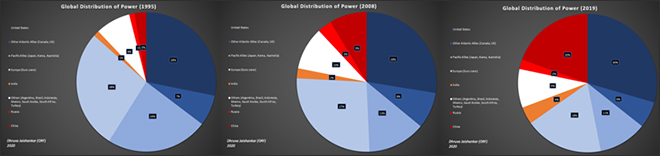
The three charts below show the changing share of nominal gross domestic product (GDP) among the G-20 economies (including the entire euro zone), which today comprise 84% of the global economy. China’s share, which was just 3% in 1995, grew from 9% to 20% between 2008 and 2019. In that same period, Europe’s declined from 27% to 18%, while the United States’ surprisingly grew from 28% to 30%. India’s share, a measly 1% in 1995, grew from 2% to 4% after the global financial crisis. While the United States has broadly held its share of global GDP among the major economies, the relative loss has been experienced primarily by Europe and Japan.
Scenario 1: A return to 2008-2019
The central question in projecting the economic distribution of power forward – in a more recessed post-pandemic world economy – is what kind of economic growth various major economies will experience as they recover. There are two possibilities to use as base lines for analysis.
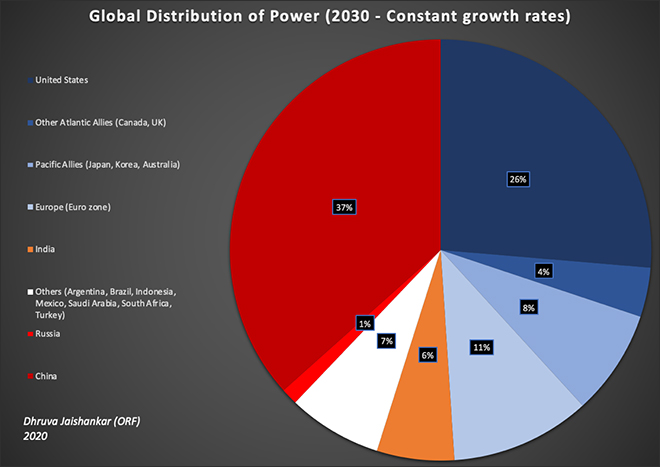
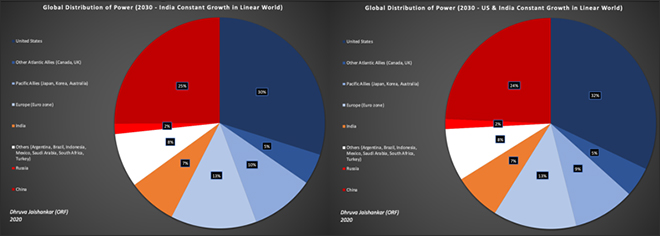
The first base scenario envisages constant rates of growth. For example, if a country averaged 4% growth between 2008 and 2019, this scenario presumes that it will maintain 4% growth between 2019 and 2030. Scenario 1 would appear both a very optimistic scenario and an ambitious objective. If this is projected forward for all major economies, this is what the distribution of power would like in 2030.
China will be the largest economy by some distance, followed by the United States. There are many reasons to doubt this outlook. One is that the coronavirus pandemic is likely to be far more devastating and disruptive than the 2008-09 global financial crisis. Another is that China’s rise in particular was showing signs of structural deceleration, suggesting that it would be harder to achieve high rates of growth as it evolved from a middle income to a high-income economy. Considerations such as debt and demographics also conspire against this possibility.
Nonetheless, this offers one very optimistic baseline. It would only be possible if certain technological innovations enable productivity increases, leading to a new wave of global economic dynamism. It may also require further expanding global market access, something that also appears unlikely at this point of time as global trade talks remain stalled.
Scenario 2: Linear growth 
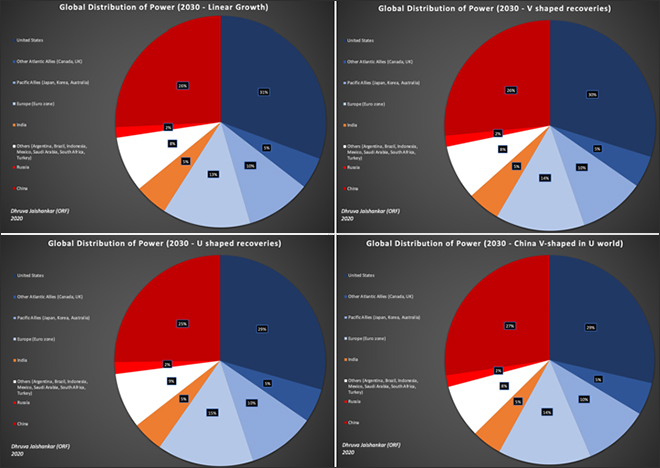
The second broad scenario, only slightly less optimistic, involves linear growth. This presumes that if an economy added $1 trillion to its economy between 2008 and 2019 that it would add $1 trillion between 2019 and 2030. If we project this forward to 2030, it creates a Scenario 2. In this scenario, the United States remains the world’s largest economy, but China is a close second.
How much might the coronavirus pandemic affect calculations? Using the International Monetary Fund’s latest projections for 2020 and 2021, it is possible to project three variations on this scenario. The first variation is V-shaped recovery: a one-year contraction followed by a one-year rebound which in turn is succeeded by a resumption of linear growth. The second is a U-shaped recovery, involving a one-year contraction, one-year rebound, three years of recessed growth, and subsequently steady linear growth. The third variation is one in which only China experiences V-shaped recovery while all others experience U-shaped growth. As these four charts indicate, these variations make little difference to the relative distribution of major economies by 2030.
What will be far more significant, therefore, is whether economies can maintain constant 2008-2019 growth rates or a more prosaic growth that is consistent but decelerates with time. The difference between those two will ultimately come down to a combination of demographics, human capital, investment regimes, technological innovation, employment, and favourable market access. 
Scenario 3: Ascendant China 
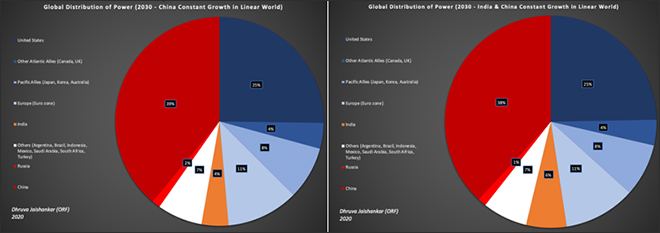
A third possibility is that China experiences a constant rate of growth for the next decade, while the rest of the world stumbles, experiencing only linear growth. In Scenario 3, China successfully transitions into a high-income economy and grows much larger than the United States. China’s economy would be almost 10 times the size of India’s. In a variation on that scenario, where China and India both grow at the faster rate, China’s economy is still over six times’ India’s size.
Scenario 4: Indian (and American) dynamism 
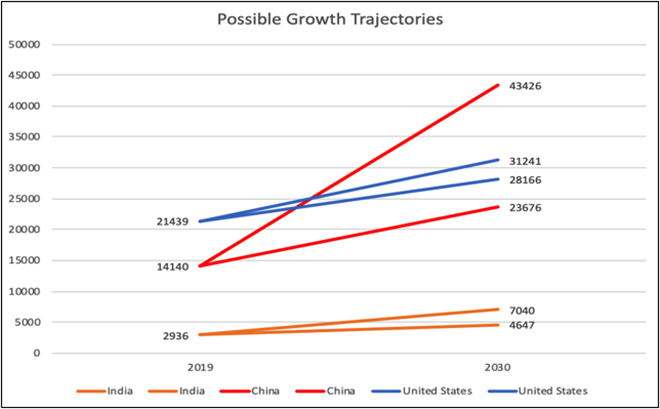
In the most optimistic scenario from India’s perspective is that India maintains a constant 2008-2019 rate of growth as the rest of the world experiences a linear recovery. This would see India benefiting tremendously from global growth over the next decade and becoming a $7 trillion economy by 2030. But as Scenario 4 indicates, India’s economy would still be about one-third that of China’s. India will have narrowed the gap, but not as significantly over a decade as some might presume. In a variation on this scenario, if India and the United States both experience the higher growth rates over this period, it still does not shift the balance of power significantly. 

Conclusion

These back-of-the-envelope projections should be taken for what they are. They do not consider extreme scenarios – so-called ‘Black Swans’ – which could possibly affect some economies: financial meltdowns, long-term recession and deflation, etc. Perhaps some countries will find that a recovery after the coronavirus pandemic is far more elusive than they had hoped. Or alternatively another set of emerging technologies may drive a new wave of global economic dynamism akin to the 1990s and early 2000s.
There are two broad conclusions to draw from this analysis. The first is that over the medium-term horizon, the severity of the coronavirus shock on economies, and their recovery, may not be as significant a determinant on future growth prospects as other factors. Specifically, the nature of growth over the next decade will be a more important determinant. The race underway by different countries to master and harness a number of emerging technologies – machine learning, automation, quantum computing, 5G telecommunications, a variety of financial and health technologies, green energy, and additive manufacturing – is therefore crucial. This foreknowledge is already driving international competition in these domains.
The second conclusion, and a very important one from India’s perspective, is that no matter how the global economy unfolds over the next decade, India is likely to remain significantly behind the two major world economies: the United States and China. The chart below shows this plainly. Given reasonable and cautiously optimistic conditions in mind, the best-case scenario would see India emerge as a roughly $7 trillion economy by 2030, by some distance the world’s third largest. But while it would narrow the gap with China, the Indian economy would still remain about one-third the its size. The worse-case scenario from India’s standpoint would be even more daunting. This would see almost a ten-fold differential, and India’s economy still about the same size as Japan or Germany.
Economic growth is important, indeed vital, for the foundations of political power. But over the medium-term future it is no substitute for important strategic decisions that New Delhi takes. In all these diverse scenarios, India has between a 4% and 7% share of the international economy among the G20 by 2030. That margin is important – not least for the welfare of average Indian citizens, and for the overall allocation of national resources. But it does not fundamentally alter the distribution of global power. The choices of how to engage, align, or respond to the other major concentrations of power – the United States, China, Europe, Japan, and Russia – as well as critical regions such as Southeast Asia, Africa, West Asia, and Latin America, will be just as consequential, no matter how fast or slow India grows over the coming ten years.

June 12, 2020

The 2020 US elections: What’s at stake for India?


When US President Donald Trump visited India in February 2020, he was riding high. The American economy looked healthy, unemployment was low, and the US Senate had just acquitted him of charges of abuse of power and obstruction of Congress. Just three months later, everything looked different. The global COVID-19 pandemic had resulted in over 100,000 deaths in the United States alone, unemployment had skyrocketed to record levels, and protests triggered by the killing of George Floyd, an African-American man, by Minneapolis police had erupted in over 100 American cities.

The dramatic change in just three months illustrates the unpredictable nature of US politics at an unpredictable time for the world, including for India. It will be all the more reason to carefully observe the US presidential and Congressional elections scheduled for November 2020.

The last four years
Trump’s 2016 election victory over Democrat Hillary Clinton threw up a number of uncertainties for India. The first was how closed or open the US would be on matters of trade, immigration, investment, and technology. The second concerned what approach he would adopt to China: confrontation, competition, cooperation, or confusion. This matter was particularly important because it would have had implications for the wider region and the world at large. The third uncertainty was how he would approach the issue of terrorism, particularly with respect to Afghanistan and Pakistan. And the fourth was what priority he would give to international institutions, and what that would mean for Indian membership and activity.

The Trump administration’s overall approach and Indian engagement with Washington helped to ensure that these areas either witnessed intensified cooperation or that damage was mitigated. The Trump administration’s Free and Open Indo-Pacific strategy, driven largely by a more competitive relationship with China, benefited India in various ways, including in bilateral defence cooperation and higher degrees of strategic coordination. The Trump administration decreased barriers for India to receive sensitive technologies, building upon some of the work done in the last two years of the Obama administration. Coordination on multilateral cooperation and Afghanistan improved, although not without bumps on the road. Occasional difficulties did arise with respect to Pakistan, given Washington’s continued equities; on immigration, although radical reform was limited by logjams in the US Congress; and especially on trade, where India was singled out for its high tariffs. Nonetheless, despite squabbling on the terms of commerce, overall two-way trade between India and the US continued to rise throughout the Trump presidency while the trade deficit in India’s favour narrowed.

Two other complications arose subsequently. The first was the Trump administration’s hardening attitude to Iran, beginning with his unilateral withdrawal from the nuclear agreement concluded by his predecessor Barack Obama: the Joint Comprehensive Plan of Action (JCPOA). The renewal of US sanctions on Iran had implications for Indian energy security. The second complication involved attempts led by the US Congress to constrain Trump’s ability to engage with Russia. The resulting legislation, known as Countering American Adversaries through Sanctions Act (CAATSA) threatened sanctions on countries for major defence agreements with Russia. India, as the largest foreign recipient of Russian defence exports, initially looked like a probable target. At the same time, Trump’s disregard for other countries’ internal affairs meant that the official US response to major changes in India — including the nullification of Article 370, which granted special status to Jammu and Kashmir, and the passage of a contested Citizenship Amendment Act — was relatively muted.

Essentially, Trump’s election had a significant impact on nine issues of importance for India. All will in some sense be at stake in November 2020. On the strategic side, this involved US policy towards China, Russia, Afghanistan/Pakistan, and Iran/Middle East. In terms of bilateral relations, the primary issues relate to trade, immigration, investment, technology, and values.

Republican vs Democratic priorities
A Joe Biden victory would provide relief to India in several areas. Not only would there be more structure and stability to a Biden administration, but the Trump administration’s obsession with redressing trade deficits, curtailing legal and illegal immigration, and isolating Iran will no longer factor prominently in US policy. Indeed, a second Trump administration will likely redouble its efforts to stem immigration, rebalance trade, and harden its stance on Iran, all of which would contribute further to Indian discomfort. Furthermore, a Democratic presidency will put one important but dormant area of cooperation — on climate change, green energy, and sustainability — back on the table with India.

By contrast, other issues might become more of a concern to the present government in New Delhi in the event of a Democratic win. Depending on who occupies key positions in the executive branch of government, we may see under a Joe Biden presidency a return to a more even-handed policy between India and Pakistan in South Asia, although not perhaps to the same degree as the 1990s and early 2000s. A Biden administration, with advocacy from the left wing of the Democratic Party, will also likely be more vocal in its criticism of India for such steps as nullifying Article 370 and CAA.

On other issues — such as investment flows and technology sharing — the consequences of the 2020 presidential elections for India will be less clear-cut. Of these, US policy on China will be by far the most consequential. Trump triggered a trade war that caught Beijing by surprise. Beyond trade, his administration has taken other aggressive steps towards decoupling the US and Chinese economies, including steps on students and technology. At the same time, his withdrawal from the Trans-Pacific Partnership and defunding of the World Health Organisation have been criticised as counter-productive. Democrats have also criticized his administration for cutting spending in areas, such as scientific research and development, that would enable the US to better compete with China. While the bipartisan consensus on China as a competitor has grown in the US, there remain differences between the parties as to how best to compete. Furthermore, constituencies outside the national security, human rights, and intelligence communities — such as those tasked with the economy or the environment — are still likely to advocate engagement and cooperation with Beijing.

Consequently, either a Trump or a Biden electoral victory in November will present the Indian government with both opportunities and difficulties. Despite a good rapport with Trump, who was favourably impressed by his visit to India, difficulties on immigration should be anticipated in the event of his reelection. While Biden will provide greater clarity and bring stability to US policy, a return to more traditional approaches to certain issues with respect to India is possible.

Prediction is premature
Predicting a US presidential election more than three months out is unwise. It is almost certain that Biden will win the popular vote, given Trump’s approval ratings and the fact that Democratic candidates have done so in six of the past seven presidential elections. Winning the Electoral College, which is what really counts, is another matter. The US presidency will be decided by no more than 17 of the 50 US states, and perhaps as few as seven. Trump will hope to retain traditionally Republican strongholds such as Arizona, Georgia, and North Carolina; win swing states such as Florida and Ohio; and surprise in at least one of the traditionally Democratic states that he won in 2016: Pennsylvania, Michigan, or Wisconsin.

Traditionally, incumbent presidents have had an edge in what are otherwise level contests between Republican and Democratic nominees, but the past three elections have thrown up uncertainty. In 2008, Republican John McCain was leading comfortably in polls in August, before the financial crisis of September benefited Democrat Barack Obama. In 2012, Obama enjoyed a comfortable lead that Republican Mitt Romney narrowed following a strong performance in their first debate. In 2016, the polls indicated a Hillary Clinton victory until election day in November. These recent trends suggest that anticipating the outcome of the presidential race before the two parties hold their conventions later this year would be premature.

Don’t forget Congress
Finally, amid the attention focused on presidency, it is often forgotten that the US Congress is also witnessing elections in November. All seats in the House of Representatives are being contested, as they are every two years, with Democrats expected to retain control of that chamber.

The contest for the Senate will, however, be significant. Should Democrats win six of seven closely contested races (Arizona, Colorado, Maine, Michigan, Montana, North Carolina, and Georgia) they would claim a majority in the upper house of the US Congress. This will give the Democrats an opportunity to define the legislative agenda (given control of both chambers), block Trump’s nominations for Supreme Court justices (should he be reelected), and put pressure on Trump in the event of another Congressional investigation into presidential wrongdoing.

For India, the Congressional relationship will remain important given the ability of the US legislature to facilitate or veto important policy. Traditionally, Congress has played a moderating role for India. When relations with the US were frosty, as during the 1980s or after the 1998 nuclear tests, India found advocates for the relationship in Congress. At the same time, when relations were more amicable, Congress often struck a more skeptical note, as when George W. Bush offered a civilian nuclear agreement to India. Regardless, this year’s Congressional elections — particularly the finely-balanced Senate — will matter almost as much for Indian interests as the presidential election.

May 16, 2020

What does COVID19 tell us about democracy vs authoritarianism?


The following article was originally published by the Observer Research Foundation on May 16, 2020.

 Few trends have been as evident or exasperating over the past weeks as the use of the ongoing novel Coronavirus (COVID-19) pandemic to advance preexisting political arguments. To those who see the pandemic and its management as a vindication of authoritarianism, or evidence of the necessity of public healthcare, or confirmation of flailing democracies, it is easy to cherry-pick examples to support these arguments. No less than Ben Rhodes, the former U.S. Deputy National Security Adviser, tweeted “It is no coincidence that countries run by right-wing nationalists are handling COVID-19 the worst (see: US, Russia, UK, Brazil),” ignoring numerous glaring examples to the contrary, such as Italy, Sweden, Hungary, or Ecuador.

So what do countries’ handling of the coronavirus pandemic actually say about the relative competence of various regime types? To make an informed assessment, it is possible to map proxy measures for governments and their success in tackling the pandemic. Freedom House’s annual Freedom in the World is ultimately subjective (and its methodology debatable), but uses a standard set of criteria to assess democracies and authoritarian governments on a scale from 0 to 100. While there are many ways to assess countries’ success in managing the pandemic, the best proxy is the number of resulting deaths per million people. This captures success in limiting the number of infections and the quality of treatment to those who are infected.

Any such analysis of these two metrics should also be accompanied by a number of important caveats. An obvious one is that the pandemic is not over. Certain countries that appeared to perform well in its early stages now appear to be worse off, while others have recovered admirably from early setbacks. Using the number of deaths per million people does not capture the secondary consequences of the pandemic, such as the resulting economic hardship that counter-measures may have caused. Ideally, the most effective governments will have minimized coronavirus casualties while ensuring a minimal impact to economies and lifestyles.

Equally, there are limitations to simple political metrics. In addition to some of its methodological shortcomings, the single Freedom House score does not capture the complexity of countries’ political characteristics, let alone their administrative or resource capabilities. Moreover, certain specially-administered territories are excluded from the political analysis. Therefore, this exercise should be seen as little more than an illustration, based on what we know so far.

There is another important point to consider, as a forthcoming working paper by Mudit Kapoor, Shamika Ravi, Anup Malani, and Arnav Agarwal makes clear. They found that 92% of reported coronavirus-related deaths were in democracies (which are home to 48% of the world’s population), while only 8% were in hybrid or authoritarian regimes (home to the remaining 52%). As they dug deeper into this disparity, they noticed that there was far more deviation around the moving average of coronavirus reporting in democracies than in authoritarian regimes. The available data from more closed systems of governance is suspiciously tidy. This suggests that authoritarian governments may be significantly underreporting coronavirus cases, including deaths linked to the pandemic.

With those important caveats in mind, what can be derived from the available data for the 182 countries and territories for which such data is available? As Figure 1 (below) shows, the trend line based on the coronavirus deaths updated on May 13, 2020 is ultimately inconclusive. While a large number of countries towards the upper end of the freedom index have high rates of coronavirus-related fatalities, a significant number of those countries fare relatively well. African countries with varying degrees of political freedom – from Ghana and Botswana to Angola and Ethiopia – appear to be equally unaffected by the virus.


As Figure 2 (below) shows, Taiwan and Iran stand as outliers on opposite ends of the spectrum, as do San Marino and Burundi.


Nor is the picture any clearer among large countries and economies. Despite a recent upsurge of coronavirus cases, India remains on the lower end among democracies in the developing world, while Vietnam – a single-party state – has had a negligible number of COVID-19 deaths. China, despite enjoying a closed political system, remains in the middle of the pack, even accounting for questions about the accuracy of its pandemic data. Neither Russia (with 14.5 deaths per million) nor Brazil (with over 50) appear to have acquitted themselves well, despite very different levels of political and social liberties.

It’s natural for political analysts and commentators to want to impose their own worldviews or thinking upon a problem, particularly one as all-encompassing as COVID-19. But there is little yet to suggest there is a strong correlation between the nature of governments and the impact of the pandemic. Other factors – per capita incomes, openness to globalisation, the nature of healthcare systems, and geographic and demographic factors – are probably more significant. Politics matters, and questions surrounding the effectiveness of democracy will be salient in the coming months and years, as the immediate threat of COVID-19 recedes. But sometimes, a pandemic is just a pandemic.

April 18, 2020

Economic vulnerabilities and power shifts in a post-Covid19 world

The following commentary was published online by the Observer Research Foundation on April 18, 2020. 

It is by now clear that the global Covid19 pandemic will have a wide-ranging impact on the world. While it is impossible to predict with any certainty the scale and spread of the coronavirus, let alone its impact on international economics, politics, and society, it is possible to systematically identify areas of potential vulnerability for the world’s major economies. The unpredictability of the effects of the virus on international politics is in part due to the multiple stages required in any reasonable analysis, each subject to many variables.

The first level of analysis is the virus itself, its effects on global public health, and immediate countermeasures taken by various national and subnational governments to stem its spread and lethality. The second is the economic effects, particularly for major economies such as the US, China and the EU, but also for major developing economies (such as India) and vulnerable smaller economies. The third is what effects the coronavirus will have on domestic politics, including the consolidation or weakening of political leaderships, possible leadership transitions and social cohesion. The fourth is what results will shape international security dynamics, whether accelerating pre-existing trends or reversing others.

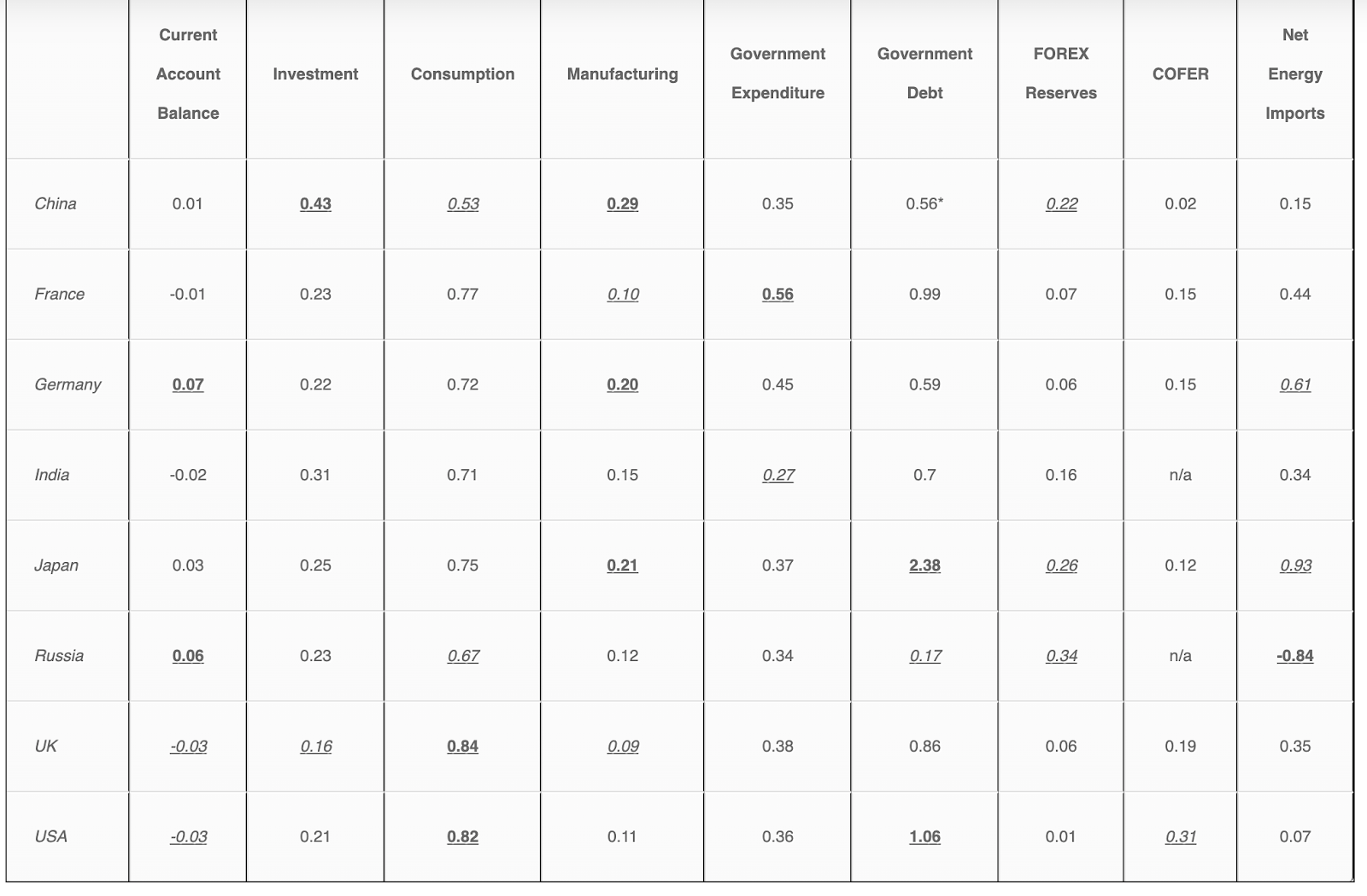
International political power derives, to a large degree, from economic power, and the last three decades have witnessed a considerable shift in this regard, reflected in Table 1 below. As the power differential has narrowed between India on the one hand, and the US, Europe and Japan on the other, it has widened relative to China. With Russia, it has swung back and forth, as a consequence of Russia’s susceptibility to energy price swings.


Varied impacts
The coronavirus pandemic will affect future trends in several ways, although the effects will vary widely from country to country. First, transnational exchanges (globalisation) will be disrupted, including trade, travel and foreign investment. Second, financial markets will take a hit as investor confidence suffers, resulting in the tightening of capital. Third, consumer spending will fall due in large part to countermeasures (such as lockdowns and travel restrictions) imposed by governments. Fourth, manufacturing output will suffer as a consequence of the previous three factors, although there will be significant variation from sector to sector. Fifth, energy consumption will decline, initially temporarily and possibly on a longer-term basis.

Governments will have many tools to try to resuscitate their economies from these effects. These will include (1) fiscal stimulus measures, (2) monetary stimuli, and (3) changes to industrial policy. The US and Japan may rely primarily on the first two, but the US government has limited control over industrial policy, while Japan’s attempts at industrial reform under the Shinzo Abe government have been frustrated. The EU only has monetary stimulus as an option, although individual member states (particularly Germany) are capable of fiscal and industrial steps. Weaknesses in Italy and Spain, which have been particularly hard hit by the Covid19 pandemic, could prove limiting. Among the major economies, only China has all three tools at its disposal, although excessive debt by state-owned enterprises will hamper these efforts.

The table below outlines in bold areas of potential vulnerability for each of the major economies; figures in italics indicate areas of relative comfort or resilience. As the table indicates, India is moderately placed on almost every criterion, with neither excessive vulnerabilities relative to others nor major causes for complacency. While Indian government spending appears low (suggesting room for fiscal stimulus measures), India’s low tax base, considerable (albeit manageable) government debt, and low credit rating erode this apparent advantage. Another area of some promise is India’s current account deficit; the pandemic offers an opportunity to redress this, both through the falling cost of commodities (especially energy) and the possibility of a manufacturing boost.


(Notes: All figures based on latest available data from World Bank and IMF.  All figures adjusted to GDP = 1, except net energy imports where total energy consumption = 1. COFER is composition of global foreign exchange reserves; figures for France and Germany adjusted to their weight in eurozone. Reserve holdings in rupee and ruble are negligible. China’s government debt figures (*) are likely understated, as they do not include debts of state-owned-enterprises.)

What next for India
What are the takeaways for India? The most important is the need for an industrial policy for the post-Covid19 world. The immediate aftermath of the pandemic presents a once-in-a-generation opportunity to implement an industrial policy on a national scale, akin to what the US did in the 1940s and 1950s and China did in the 1980s and 1990s. This will only be possible through a series of far-reaching measures, given the great disparity between India’s states and limited room for fiscal manoeuvre. Identifying key manufacturing outputs as national security priorities; providing tax incentives, land acquisition potential, and single window clearances to those planning to manufacture in these areas; improving the secondary debt market to enhance investment; boosting government spending on R&D in critical areas (for instance, health research); and incentivising STEM research at higher education institutions will be necessary. Critical physical infrastructure (highways, rail, ports, high-speed data) and the instruments of national security (defence, cyber, space) offer additional priorities for such a national industrial policy.

A second priority will require observing China’s recovery and response, given its economic and strategic weight. China’s economy is particularly susceptible to declines in foreign investment, manufacturing, and export markets. Declines here could challenge the credibility of the Chinese Communist Party, which explains in large part Beijing’s attempts to shift the narrative focus in its political messaging. Should Beijing implement a full range of measures to stimulate economic recovery, as appears likely, this would artificially inflate growth. At the same time, other countries’ attempts to disincentivise investment into China and increase barriers to market access on national security grounds will negatively impact its medium-term growth prospects. In China, perhaps more than other major economies, economic performance is tied closely to political sensitivities and security policy. Consequently, there will be inevitable concerns about diversionary tensions. India experienced this first-hand in 1962 in the wake of the disastrous Great Leap Forward. Managing these multiple challenges will require India to continue its positive engagement with China, as began at Wuhan in 2017, while accelerating cooperation with balancing powers in the wider region to hedge against various possibilities. An acceleration of India’s ‘Act East’ and ‘Indo-Pacific’ policies—within perhaps more limited means—is therefore an inevitable consequence of the coronavirus pandemic.

A third priority will necessitate tracking developments in the US. The US, which could end up with the largest number of Covid19 infections and deaths, will almost certainly witness the end to the longest period of economic growth in its history. Its economic indicators—including unemployment and the stock market—have already faced severe downturns. But as the US has experienced shocks of this nature before, it can be expected to witness an eventual recovery, likely gradual, helped both by a massive stimulus and buttressed by the strength of the dollar. But the dip will present challenges for India, both in seeking investment from the US and possible complications resulting from a potentially restrictive immigration regime. Bilateral commercial consultations that can identify avenues of mutually beneficial post-Covid19 economic cooperation will be urgently needed.

Moreover, Covid19 will have uncertain effects on US politics. President Donald Trump initially received a boost in approval ratings as the crisis hit, followed by a small slump. Joe Biden, who is the presumptive Democratic presidential nominee, leads Trump in national polls. However, the margin is in fact a lot closer than national surveys imply: polling in key swing states and the demographics of likely voters suggest that Trump may enjoy an edge in the Electoral College. The pandemic will also disrupt important Congressional races. While India is unlikely to be adversely affected by the either the presidential or Congressional elections, it will be important to engage with key stakeholders across the political spectrum, including campaign advisors and legislative leaders, on the panoply of issues that are vital for Indian interests.

Finally, although there will be several other effects for India—major and minor, global and regional—that are harder to anticipate, a potential silver lining could involve a medium-term suppression of energy prices. This would have a positive effect for India’s current account deficit, which in turn would result in opportunities to streamline subsidies and thereby free up fiscal space for other vital investments. Such investments could include capital expenditure in defence, which faced constraints in 2020-2021, as well as foreign assistance, which will be in high demand worldwide and if targeted strategically could confer long-term benefits for India. Additionally, depressed fossil fuel prices could be used as an opportunity to accelerate India’s energy transition to liquified natural gas, which ought to feature in bilateral discussions with major suppliers such as Qatar, the US, Russia, and Australia. At the same time, prioritising solar energy components—an area of supply chain vulnerability for India—will be necessary for the future of the National Solar Mission, as part of long-term energy security plans.

There is no question that the scale and spread of Covid-19 will mean economic setbacks across the board. But, as during the 2007-09 global financial crisis, some actors will emerge relatively better off than others. If India seeks to bounce back relatively strongly, while guarding against further adverse implications (including security), it will have to consider the wide range of possibilities along a few key dimensions.